
Florida water birds are often the first sign that a landscape is doing more than sitting still. A heron waits at the edge of a marsh. An anhinga dries its wings on a branch. A spoonbill sweeps its bill through the shallows. Even a quiet pond can turn into a small theatre once you notice who is feeding, wading, diving, or simply passing through.
This guide is not a complete species list. It is a practical way to begin looking. Read the water, notice a bird’s shape and behaviour, then let those details lead you toward a better identification. The same observations can make Florida art more meaningful too, because a wading bird or a dark line of cypress is never just decoration. It is a clue to a living place.
Start with the habitat, not the name
The quickest way to understand Florida water birds is to start with where they are standing. Freshwater lakes, cypress swamps, grassy marshes, mangrove shorelines, beaches, tidal flats, and open bays all offer different food and cover. A long-legged bird probing in a shallow edge is using a different part of the landscape from a duck paddling through open water or a pelican diving beyond the surf.
The University of Florida’s guide to common aquatic birds on Florida lakes groups water birds by habitat and feeding patterns, including waterfowl, marsh birds, shorebirds, and wading birds. That is a useful first filter. You do not need to know every feather pattern. First ask whether the bird is wading, swimming, diving, scanning from above, or working the sand line.
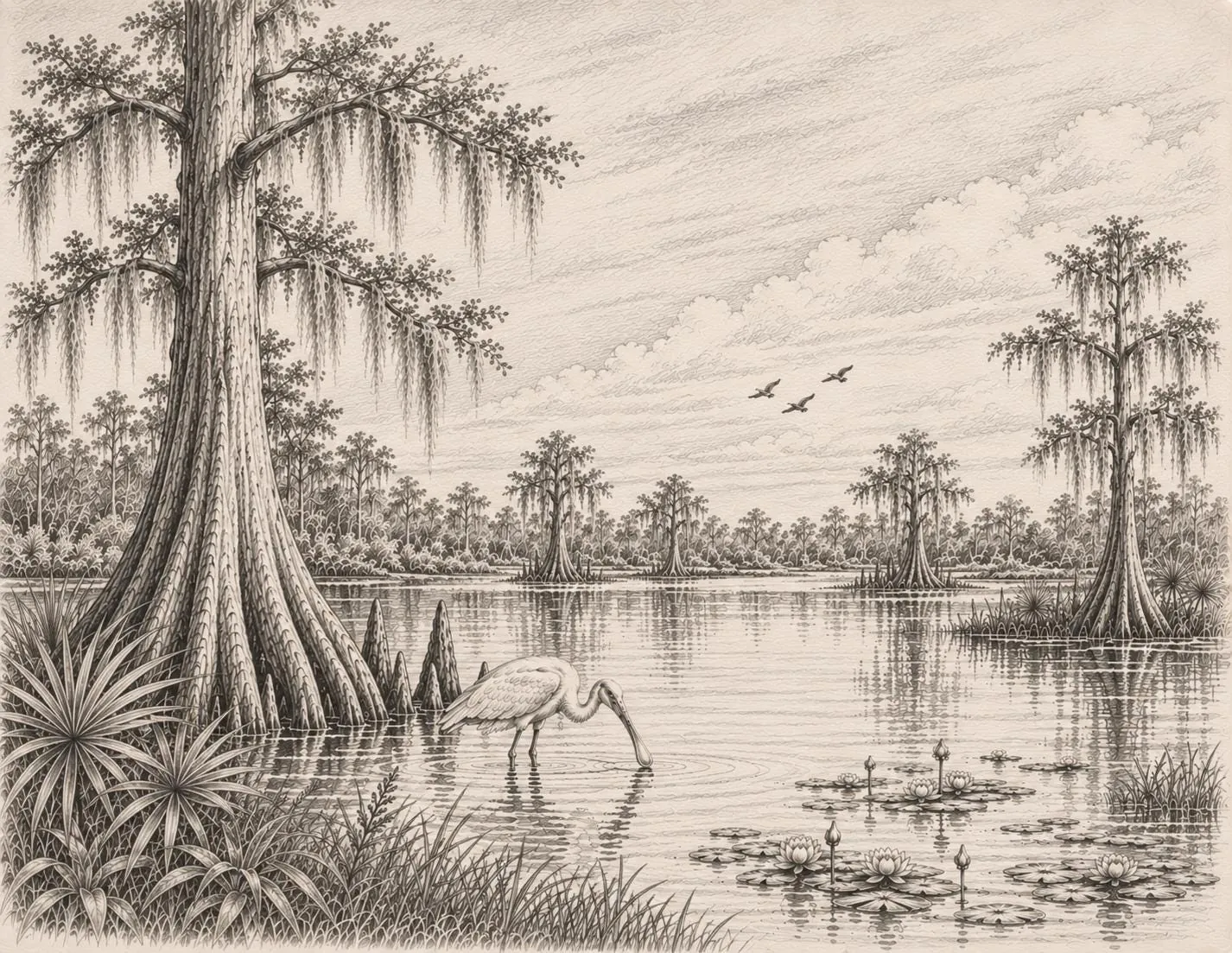
Water depth matters more than it may seem. Herons and egrets need a shallow enough margin to walk and strike at prey. Ducks need room to swim and feed. A dense stand of plants may shelter some birds while making it harder for a diving bird to move through the water. When you look at a wetland scene, those differences help explain why one bird belongs in the foreground and another appears farther out.
Wading birds: the tall shapes at the water’s edge
Herons, egrets, ibis, spoonbills, storks, and cranes are among the most recognisable Florida water birds because their long legs and long bills make such clear silhouettes. They are built to work the shallows slowly. A great blue heron may stand nearly motionless before striking. An egret can look impossibly white against dark water. A white ibis uses its curved bill to probe soft ground, while a roseate spoonbill sweeps its broad bill side to side through the muck.
The useful visual clue is the relationship between leg, neck, and bill. A bird with long legs and a long neck is often a wader, but the bill shows how it feeds. The Audubon Florida bird guide describes roseate spoonbills as shallow-water feeders that swing their heads through the mud, while great egrets are tall, stately white waders of quiet water. Those actions are easier to remember than a list of names.

Look for posture too. A heron often carries a tucked, S-shaped neck in flight, while a stork or crane has its own more extended profile. On the ground, a wader may feel patient rather than busy. That stillness is one reason bird art belongs so naturally in a calm room. A single vertical heron can add height and attention without asking the wall to become loud.
Waterfowl: ducks, geese, and the birds on open water
Waterfowl is the broad name for ducks, geese, and swans. These birds are made for swimming, with webbed feet and bodies that sit low on the water. Florida has both year-round residents and winter visitors, so the mix can change with the season. A small pond that feels quiet in summer can hold more ducks and coots when northern birds arrive.
The Florida Fish and Wildlife Conservation Commission reports that about 20 waterfowl species migrate to or through Florida in fall and winter. Its waterfowl identification guide notes that blue- and green-winged teal, shovelers, and other puddle ducks favour shallow marshes, while scaup gather in brackish marshes and lagoons. Florida mottled ducks, wood ducks, and black-bellied whistling ducks are among the birds that can be found year-round in wetland habitats.
For a beginner, aim for broad distinctions first. Does the bird float high or low? Is it dabbling at the surface, tipping forward, or diving? Is it alone, paired, or in a loose flock? These observations make a field guide far more useful, and they keep you from mistaking every brown duck for the same species from a distance.
Divers, swimmers, and birds that work open water
Anhingas and cormorants offer a very different shape from a wader. They swim low, dive for food, and often perch with their wings spread. In a cypress swamp or lake, an anhinga’s long neck and pointed bill can make it look almost like a line drawn across the water. Ospreys belong to this open-water story too, but they hunt from the air, watching the surface for fish before diving.
UF/IFAS explains that anhingas and double-crested cormorants swim through the water to catch fish and other aquatic prey, so extremely dense underwater vegetation can get in the way of how they feed. Ospreys, by contrast, search from above and benefit from a clear view into the water. That difference is worth noticing whenever you see a lake: the same water can support several kinds of bird because each uses it differently.

If you want a simple viewing habit, pause before you raise binoculars or reach for an app. Watch for one minute. The movement often gives away the bird’s group before you can see the colour clearly. A bird that stalks, swims, dives, or circles overhead is telling you exactly what part of the habitat it needs.
Beach and shore birds need a little more space
Florida’s beaches, sandbars, mudflats, and tidal edges host birds that are easy to admire and easy to disturb. Plovers, sandpipers, oystercatchers, terns, gulls, skimmers, and pelicans use these open places to feed, rest, and in some cases nest. Their small scale can make them harder to notice than a large heron, especially when they blend with sand or gather in a resting flock.
On a beach, distance is part of good birdwatching. Stay outside marked nesting areas, keep pets away from birds, and resist the urge to walk closer for a photograph. Audubon notes that least terns nest on open ground and can be affected by human use of beaches, while black skimmers fly low with their lower bill cutting the water’s surface to find fish. Those remarkable behaviours are best appreciated without making the birds change theirs.
Binoculars, a zoom lens, or simply a patient seat well back from the shoreline will show more than a close approach. If a bird begins calling, moving away, or acting alert because you are there, it is time to give it more room. The point is not to collect a perfect sighting. It is to leave the place as calm as you found it.
How season changes what you see
Florida’s warm climate means water birds are visible all year, but the cast changes. UF/IFAS notes that resident and migrant aquatic birds can use lakes year-round, with some becoming more abundant in winter as birds move south. The FWC likewise identifies fall and winter as key times for migratory waterfowl. That makes a winter walk around a lake, marsh, or lagoon especially rewarding for anyone learning to notice birds.
Season is also a reminder not to promise yourself a particular species on every visit. Rainfall, water level, plant growth, weather, tide, and migration all shape what is present. A quiet visit can still be a good one. Look at the reflected sky, the water line, the cypress knees, and the tracks in the mud. Birdwatching becomes more satisfying when the whole habitat is part of the experience.

A simple way to watch without needing to be an expert
Start with one place you can return to. It might be a neighbourhood pond, a boardwalk through a preserve, a quiet bay edge, or a beach you already know. Go at roughly the same time on two or three visits. The goal is not to make a long checklist. It is to notice what changes when the wind is stronger, the water is lower, or the light is moving toward evening.
On each visit, make four small observations. First, look at the water itself. Is it open, shallow, grassy, muddy, tidal, or covered with floating plants? Second, count the broad kinds of birds before trying to name them: waders, swimmers, divers, or birds passing overhead. Third, watch one individual for long enough to see how it feeds. Finally, listen for the rest of the place. A call from reeds or the wingbeat of a bird leaving a roost can be just as informative as a clear view.
Then use a field guide or identification app to check your best guess. The Florida Fish and Wildlife Conservation Commission is clear that practice matters when identifying waterfowl, and that is true more broadly. An app can offer a useful second opinion, but it cannot replace looking carefully at habitat, shape, and behaviour. Write down what you observed even when you cannot put a species name to it. “Tall white wader at a grassy lake edge, moving slowly” is a meaningful note.
Keep the experience light. If you have children with you, let everyone choose one bird or one interesting detail to watch. If you are walking alone, leave the phone in your pocket for a few minutes before taking a photo. The best outcome is often not a rare sighting. It is the moment when a familiar pond stops feeling ordinary because you recognise the lives moving through it. Return after rain, during a cold spell, or when the water is unusually high, and the same shoreline may tell a completely different story.
Bring the feeling of a wetland home
Designs By M Wright takes inspiration from the same details that make Florida water birds memorable: a heron’s stillness, a cypress reflection, marsh grass in low light, and the open space around water. If a bird study speaks to you, start with the Heron Wall Art collection. For scenes that hold birds, trees, and water together, browse Old Florida Art or the Wetlands Fall Collection.
A good nature print does not need to explain everything. It can simply give the eye a place to pause. Choose a subject you would look at on a real walk, frame it simply, and let the room keep some quiet space around it. That is often enough to bring home a genuine sense of place.

