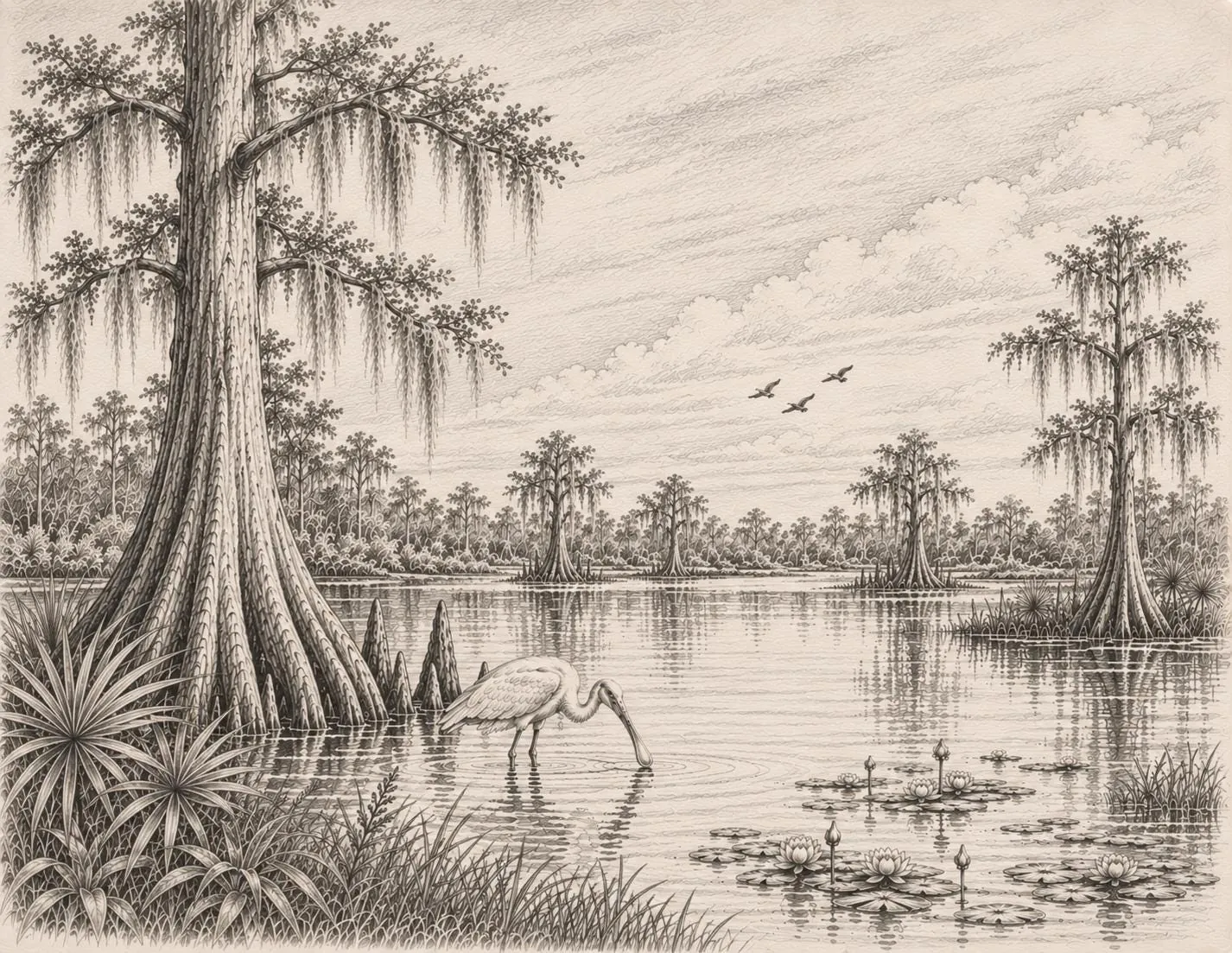
Florida wetlands are easy to pass without really seeing. A stand of cypress beside a road, a grassy edge of a lake, a shallow place full of birds, or a quiet strip of mangroves may look still from a distance. Up close, each is a working landscape of water, soil, plants, insects, fish, and wildlife, changing with rain, season, and light.
This field guide is for anyone who wants to look a little longer. It is not a guide to identifying a wetland boundary or a substitute for local advice about a property. It is a way to understand the character of the places that inspire so much Florida art: why a cypress reflection, marsh grass, or wading bird can hold a room’s attention without needing to be loud.
What makes a Florida wetland?
Water is the beginning, but it is not the whole story. The Florida Department of Environmental Protection’s definition of wetlands centers on land that is inundated or saturated often enough to support vegetation adapted to saturated soil. That is why a wetland may not look like open water every time you visit. The ground, plants, and pattern of water all matter.
In practical terms, wetlands sit in the conversation between land and water. Rain may collect there. Groundwater may rise close to the surface. A river or lake may spill into the surrounding low ground after heavy weather. Plants that can tolerate those conditions take hold, and animals use the food, shelter, and shallow water those plants create.
The official list is wonderfully varied: swamps, marshes, bogs, cypress domes, sloughs, wet prairies, riverine wetlands, tidal marshes, and mangrove swamps all belong in the Florida wetland picture. The common thread is not one exact look. It is the repeating relationship between water, wet soil, and life adapted to both.

Cypress swamps: shade, reflection, and slow water
A cypress swamp is often the version of Florida that stays with people. Bald cypress and pond cypress create a tall, deliberate silhouette, with broad trunks, knees, Spanish moss, and dark water that doubles the trees in reflection. The scene can look hushed, but it is not empty. Ferns, buttonbush, lizard’s-tail, fish, insects, reptiles, and birds all use different parts of the same place.
The Florida Fish and Wildlife Conservation Commission describes cypress swamps as wetland communities along rivers, creeks, lakes, or shallow depressions, dominated by bald or pond cypress. Frequent flooding is part of what keeps this habitat functioning. When water patterns are dramatically altered, the character of the swamp changes with them.
For a visitor, the most useful habit is to notice layers. Look at the canopy first, then the trunks and waterline, then the small plants at the edge. If a bird is present, watch whether it uses a branch, a shallow margin, or open water. A cypress scene becomes richer when you stop treating it as a backdrop and begin seeing its separate rooms.

Marshes: open water with a living edge
Marshes usually trade trees for grasses, reeds, sedges, water lilies, and other soft-stemmed plants. They feel more open than a swamp, which makes their shifting patterns of light, sky, and water easier to see. Some are freshwater, some are brackish, and some follow the pulse of the tide. What connects them is shallow water and plants adapted to live with it.
The Florida Fish and Wildlife Conservation Commission’s freshwater habitat guide notes that shallow marshes can hold woody species as well as plants such as spikerush, pickerelweed, and arrowhead. In the Everglades, a vast freshwater marsh, seasonal water levels help shape where fish find cover and food. The water is not merely scenery. It sets the rhythm for the entire community.
That rhythm is why a marsh can look so different from one month to the next. After rain, water may spread farther across the grasses. In a drier spell, open water can pull back and reveal more of the muddy edge. Neither moment is the whole story. A marsh is built around change, and the best way to understand one is to return more than once.

Water gives each season a different mood
Florida does not divide the year into four equally distinct seasons, but wetlands still make the calendar visible. During the wetter months, higher water can soften familiar edges and spread into low places. Grasses grow tall, reflections widen, and birds may use a different part of the habitat than they did a few months earlier. The dry part of the year can make water feel more concentrated, drawing attention to deeper pools, open channels, and the animals that gather near them.
The Everglades is a clear example. The FWC explains that its marshes are generally wetter from May through November and lower from December through April, a pattern that changes how fish use the landscape. You do not need to visit the Everglades to notice the same basic idea. A neighborhood lake, a roadside cypress stand, or a coastal marsh will also show the effects of rainfall, water level, wind, and tide.
That is good news for anyone who enjoys looking slowly. Return to one nearby place in more than one season. Notice where the water meets the plants, whether the sky is reflected or broken by grass, and whether the birds are spread out or gathered closer together. The repeated visit gives the landscape a story, and it makes a wetland print at home feel less like a general symbol and more like a memory of how a real place changes.
Why wetlands feel full of wildlife
Wetlands offer many kinds of food and cover in a small space. Shallow water supports insects and tiny aquatic life. Plants shelter small fish and give birds places to hunt or nest. Fallen wood, mud, grass, and open water each invite a different resident. It is a busy system, even when it looks calm enough to hold only one heron.
Florida’s freshwater wetlands support fish, amphibians, reptiles, mammals, and birds, but it helps to start with what is easiest to see. Watch the waterline for a wader. Look for movement near a clump of reeds. Pause under a cypress to listen. The Florida water birds guide in this journal can help you read those birds by their habitat and feeding style, rather than trying to memorize every species at once.
A wetland’s value also extends beyond the animals in view. Floodplains can hold water after high water events, and the FWC describes them as crucial habitat for the productivity of some river systems. Healthy wet places can slow water down, give it room to spread, and support the living connections between lakes, rivers, estuaries, and the coast.
What to notice on a first walk
You do not need a rare sighting or a long checklist to have a meaningful wetland walk. Start with four simple observations. First, look at the water: is it still, moving, clear, tea-colored, shallow, or hidden beneath plants? Second, look at the dominant shape: trees, grasses, open sky, mangroves, or a mix. Third, notice one animal’s behavior. Finally, listen before you take a photograph.
Those details make it easier to remember a place honestly. Instead of saying, “I saw a swamp,” you might remember dark water under cypress, the sound of anhinga wings, and a white egret at the far edge. Instead of saying, “It was marshy,” you might remember a wide line of grass, lilies near the bank, and wind rippling through the taller stems.
If you want to find a nearby place to explore, start with a public preserve, park, or boardwalk and follow posted guidance. The FWC habitat resources also point to mapping tools that describe wetland types and wildlife habitat. Use those resources as an invitation to learn, not as proof of a legal wetland line on a particular property.
How to look without disturbing the place
The best wetland watching is quiet and patient. Stay on paths and boardwalks where they are provided. Keep enough distance that birds do not change their behavior because you are near. Give nests, resting flocks, and young animals extra room. A long lens or binoculars can show far more than a closer approach, and they let the landscape remain calm for the next visitor too.
It also helps to leave the scene as you found it. Do not collect plants, feathers, nests, or pieces of wood. Keep dogs where they are allowed and controlled. Bring water, insect protection, and sun protection, then take your litter home. These small choices make it possible to enjoy the detail of a wetland without turning curiosity into pressure on the habitat.
For work near a wetland, a walk and an online map are not enough to make a decision. The Florida Department of Environmental Protection explains that wetland identification relies on water patterns, soil, and vegetation, and that the state uses a formal method for delineation. That is a job for the appropriate experts and agencies, not a guess from a dry-day view.
Why these places stay with us
Wetlands are visually generous without being showy. They offer vertical lines of cypress, a low horizon of grass, a small point of white from an egret, and water that turns the sky into part of the ground. Even when the palette is quiet, there is a lot to look at. The scene asks for attention rather than demanding it.
That may be why wetland landscapes work so well in a home. They do not need to perform like a postcard. A piece with dark water, weathered trees, or a distant bird can make a room feel calmer because it gives the eye depth and somewhere to rest. The details keep revealing themselves, much like a familiar path where you notice something different on each visit.
When choosing art inspired by a wetland, begin with the kind of place you recognize. Perhaps it is a wide marsh at sunset, a shaded cypress stand, or a bird at the waterline. Let the print’s light and scale guide the frame and wall around it. The aim is not to create a theme. It is to keep one honest feeling from the outdoors close at hand.
Bring a sense of wetland home
Designs By M Wright draws from the quieter details that make Florida wetlands memorable: cypress trunks, still water, layered marsh grass, weathered light, and the patience of a wading bird. A Wetlands Fall Collection print can give a living room, bedroom, or entry that same pause between water and land. For a more nostalgic interpretation, explore Old Florida Art.
Choose the scene that feels familiar, even if you cannot name every plant or bird inside it. A good nature print does not have to recreate a whole landscape. It can bring back the feeling of a real walk: the open space, the reflected light, and the sense that something alive is just beyond the frame.

